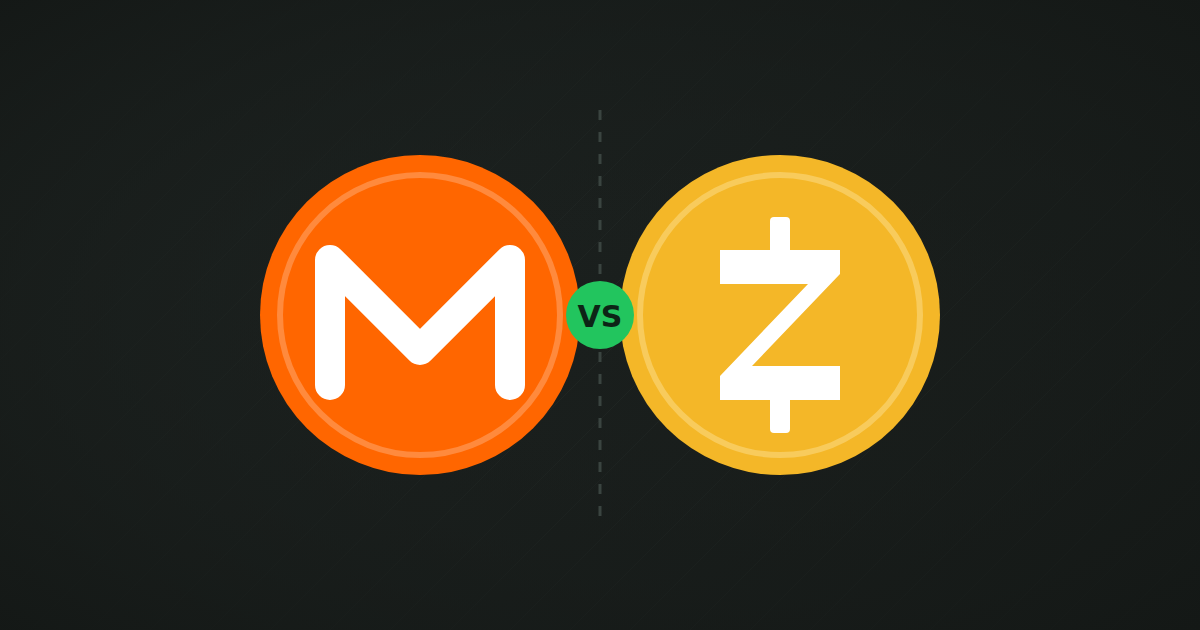
Monero vs Zcash: two very different roads to private money
Both coins promise privacy, but they get there in opposite ways. One hides everything by default, the other lets you choose. Here is what that means in practice.
Bitcoin is often called anonymous. It is not. Every payment sits on a public ledger forever, and with a little work, addresses can be grouped and linked to people. Monero and Zcash were both built to fix that, but they made very different choices.
Monero: private by default
Monero hides three things in every single transaction:
- Who sent it. Ring signatures mix your real input with decoys taken from the blockchain, so an outsider cannot tell which one was spent.
- Who received it. Stealth addresses mean every payment goes to a fresh one-time address. Your public address never appears on the chain.
- How much. RingCT hides the amounts while still letting the network check that no coins were created from nothing.
Because this applies to everyone, all Monero transactions look alike. That is the key strength: your privacy does not depend on what other people choose to do.
Zcash: privacy you opt into
Zcash uses zero-knowledge proofs (zk-SNARKs). A shielded transaction proves it is valid without revealing the sender, receiver or amount. The cryptography is very strong.
The catch is that Zcash also has transparent addresses that work like Bitcoin. Shielded and transparent funds live side by side, and for most of its history a large share of activity has used the transparent side. When you move coins between the two, the amounts and timing can give you away.
Modern Zcash wallets default to shielded addresses, and the gap has narrowed. But privacy in Zcash is still something you have to keep choosing.
Which one should you use?
- For everyday private payments, Monero is the simpler choice: there is no wrong button to press.
- For holding value privately, both work, as long as Zcash funds stay fully shielded.
- For exchanges, Monero is far more widely supported by no-KYC instant exchanges.
Whatever you pick, the weak spot is usually the edge: the moment you buy or sell. That is where an exchange that does not ask for ID matters most. You can filter for exchanges with a guarantee and a 5-star KYC score on our homepage.